
Gillco Ingredients – Food science insights and technical blog
Technical Knowledge & Insights

Food Ingredient Blog & Updates

Formulation insights, industry trends, and technical guidance from our food science experts.

0%

Global buyers are reassessing what belongs inside modern frozen foods. Ingredients must survive freezing, transport, reheating, and long storage. Texture matters. So does label clarity.

The 2024 Power of Frozen report from FMI and the American Frozen Food Institute valued U.S. frozen retail sales at approximately $72.2 billion in 2023. Its findings show strong household demand, even during price-sensitive periods. Meanwhile, Innova Market Insights identifies health, convenience, protein, and sustainability as major global food-development themes. These signals point toward practical priorities: modified starches for stable texture, hydrocolloids for freeze-thaw control, natural flavors for sensory consistency, and plant or dairy proteins for nutritional positioning. Definitions differ between reports, however. That limitation deserves attention.

Food scientist David Julian McClements has described clean-label expectations as a demand for “simple, natural, and recognizable ingredients.” His observation is especially relevant to frozen formulations, where functional performance cannot disappear behind a short ingredient list. Buyers may therefore compare more than price. They should examine supplier traceability, allergen controls, technical documentation, cold-chain experience, and batch-to-batch consistency. A bright mango filling should remain aromatic after thawing. A breaded coating should stay crisp, not collapse into a wet shell. Small formulation choices create large commercial consequences.

The strongest sourcing strategy balances function, cost, regulatory suitability, and consumer trust. No single ingredient wins every market. Regional eating habits, climate, processing equipment, and labeling rules can change the answer. That is why this guide examines the top Frozen Food Ingredients for global buyers, with evidence, practical context, and room for informed doubt.
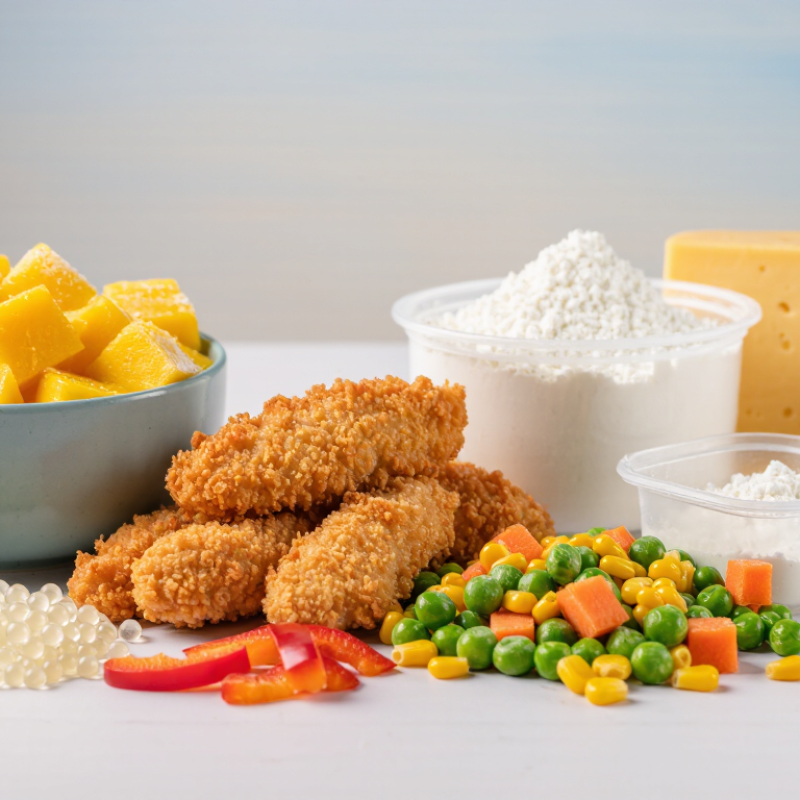
What Are the Top Frozen Food Ingredients for Global Buyers?

Defining Frozen Food Ingredients and Their Role in Global Food Production

Frozen food ingredients are the edible components used to create, preserve, and improve frozen products. They include vegetables, fruits, meat, seafood, grains, oils, starches, seasonings, and functional additives. These ingredients must perform well after freezing, storage, transport, and thawing.

Quality matters.

For global buyers, popular choices often include individually quick-frozen vegetables, fruit pieces, poultry, seafood, potato products, and plant-based proteins. Starches and hydrocolloids can support texture in sauces, fillings, and ready meals. Edible oils improve cooking performance and mouthfeel. Salt, herbs, and spice blends shape flavor, but their use must match regional preferences and labeling rules.

Frozen ingredients are not selected by price alone. Buyers should review moisture levels, particle size, freezing method, microbiological controls, allergen information, and shelf-life data. Reliable suppliers should provide clear specifications, batch records, traceability documents, and consistent samples. Cold-chain stability also matters, since repeated temperature changes can create ice crystals and damage texture. A practical review should compare product performance after thawing, not only its appearance when frozen.

No ingredient is perfect.

A low-cost vegetable may produce more waste after cooking. A strong stabilizer may protect texture but change the eating experience. Even accurate specifications cannot remove every supply risk. Seasonal variation, port delays, and changing harvest conditions require careful planning. Global buyers need technical knowledge, direct communication, and regular quality checks to make frozen ingredients dependable in real food production.

Classifying Frozen Food Ingredients by Function, Source, and Application

What Are the Top Frozen Food Ingredients for Global Buyers?

Frozen food ingredients are best classified by function, source, and application. Functional ingredients include proteins, starches, fibers, stabilizers, emulsifiers, and antioxidants. They control texture, moisture, color, and freeze-thaw performance. A sauce should remain smooth after thawing, not watery. Small details matter.

By source, buyers commonly assess plant-based, dairy-derived, animal-derived, marine, and fermentation-based ingredients. Plant proteins and fibers support clean-label formulations and cost control. Dairy ingredients improve creaminess and protein content. Fermentation-based ingredients may support flavor and processing efficiency. Buyers should verify allergen statements, origin records, microbiological controls, and cold-chain performance. The Food and Agriculture Organization reported that about 14% of food was lost between harvest and retail globally in 2019. Better ingredient stability can reduce avoidable waste, although it cannot solve weak logistics.

Application changes the purchasing priorities. Ready meals need stable sauces and firm vegetables. Frozen bakery products require dough strength and moisture retention. Desserts often depend on controlled ice-crystal formation. Seafood products require texture protection and oxidation control. The United Nations Environment Programme estimated 1.05 billion tonnes of food waste in 2022. Frozen formats may extend usability, but energy use and packaging remain important concerns. Classification helps comparison, but it is not perfect. A multifunctional ingredient can improve texture while complicating labeling or regional approval. Testing under real transport conditions is still essential.

Top Frozen Food Ingredients for Global Buyers

Classified by function, source, and application. The chart shows practical indicative inclusion ranges in finished frozen products, not market-share estimates.

Water and proteins are structurally important in frozen meals, seafood, meat, and plant-based products. Starches, sugars, oils, salt, hydrocolloids, and acids support texture, flavor, freeze-thaw stability, and shelf-life performance across vegetables, bakery products, desserts, and ready meals.

Identifying the Most Common Ingredients Used in Frozen Foods Worldwide

Global buyers commonly encounter potatoes, poultry, seafood, wheat flour, rice, vegetables, and cooking oils in frozen foods. These ingredients appear across many regional product categories. Peas, corn, carrots, spinach, onions, and peppers are especially common in frozen mixes. They retain useful color and texture when processed quickly and stored consistently. Poultry and fish provide familiar protein options for retail meals and foodservice products.

Wheat flour often supports frozen pizza, breaded items, dumplings, and pastries. Rice and starches help create structure, thickness, or a stable bite.

Vegetable oils improve frying performance and mouthfeel. Salt, sugar, herbs, spices, and sauces shape flavor, but their levels vary widely between markets.

Clean labels may be important in one region, while cost and cooking performance matter more in another.

In supplier reviews, buyers should check ingredient origin, allergen controls, moisture levels, and cold-chain records. Frozen ingredients are not automatically consistent. A vegetable can lose firmness after repeated temperature changes. A coating may become soft during transport. I have also seen specifications that looked precise but left texture expectations unclear. That weakness deserves attention. Buyers should request samples, compare batches, and define measurable standards for size, color, flavor, and defect tolerance before large-scale purchasing.

Evaluating Quality, Safety, Shelf Life, and Regulatory Requirements

What Are the Top Frozen Food Ingredients for Global Buyers?

Global buyers often prioritize frozen vegetables, berries, seafood, poultry, and prepared ingredients. Yet popularity means little without measurable quality. Color, cut size, glazing, and texture should match the agreed specification. A sample may look excellent while cartons hide crushed pieces. Inspect both levels. Test incoming lots for temperature, foreign matter, pesticide residues, allergens, and microbial risks. Keep documented sampling methods. Safety needs evidence, not confident language. Reliable suppliers provide batch codes, origin records, processing dates, and laboratory results.

Shelf life depends on more than a printed date. Stable freezing, commonly at or below -18°C, limits quality loss, but transport interruptions still matter. Ice crystals, torn liners, and freezer burn reveal weak cold-chain control. Buyers should review temperature logs from loading to arrival. Packaging must withstand stacking, condensation, and repeated handling. Some ingredients retain flavor for months; delicate berries and seafood can lose texture sooner. Long shelf life is not a universal promise.

Regulatory review should cover the destination market, not only the exporting country. Check permitted additives, allergen declarations, nutrition rules, language, traceability, and import documents before contracting. Requirements can change, and translated labels may contain avoidable errors. A practical audit combines factory records with physical inspection and independent testing. Still, no checklist removes every risk. Overlooking a small labeling detail can delay a full shipment. Buyers should record exceptions, challenge optimistic claims, and update specifications after real performance data.

Comparing Suppliers, Costs, Certifications, and Global Supply Reliability

Global buyers are prioritising frozen vegetables, fruit, seafood, and prepared ingredients. The OECD-FAO Agricultural Outlook 2024-2033 expects agricultural and fish commodity consumption to grow about 1.1% annually. Demand is expanding, but supplier quality remains uneven.

Price is only one part of the decision. Compare raw material costs, freezing energy, packaging, storage, inland transport, and port charges. A supplier offering 8% lower prices may lose that advantage through temperature delays or high rejection rates. Request HACCP records, ISO 22000 certification, allergen controls, pesticide testing, and recent audit results. The Codex Alimentarius principles provide a useful safety reference. Certifications help, but certificates alone cannot prove daily discipline.

Tips: Ask for three delivered-cost quotations, not factory prices. Check production capacity during peak harvest months. Require temperature logs below -18°C where applicable. The World Bank Logistics Performance Index 2023 highlights reliability, tracking, and timeliness as core logistics measures. Build backup origins for important ingredients. This costs more initially. It may prevent shortages later. One weakness in this approach is that supplier data can look perfect on paper. Independent testing and a small trial shipment reveal more. Also, global freight conditions change quickly, so a six-month contract should include review points for energy and transport costs.

What Are the Top Frozen Food Ingredients for Global Buyers? - Comparing Suppliers, Costs, Certifications, and Global Supply Reliability

Frozen Ingredient Typical Supplier Regions Common Commercial Forms Indicative Bulk Price
(USD/MT, FOB)
Typical Pack Sizes Common Certifications Supply Reliability Key Buying Considerations
Frozen Green Peas Europe, North America, China, India, New Zealand Whole, petit pois, diced, IQF 800–1,300 400 g retail; 1–2.5 kg foodservice; 10–25 kg bulk HACCP, ISO 22000 or FSSC 22000, BRCGS, IFS; organic options available High
Multi-region production and established processing infrastructure
Check size grading, sweetness, blanching quality, color retention, and pesticide-residue compliance.
Frozen Sweet Corn United States, Canada, China, Thailand, Hungary, Poland Kernels, cob pieces, diced, IQF 700–1,100 400 g retail; 1 kg foodservice; 10–25 kg bulk HACCP, BRCGS, IFS, ISO 22000 or FSSC 22000; non-GMO and organic options High
Broad growing geography and strong frozen demand
Confirm kernel maturity, cut size, sweetness, foreign-material controls, and non-GMO documentation.
Frozen Spinach China, Belgium, Spain, Poland, Turkey, Egypt Leaf, chopped, blocks, portions, IQF 900–1,600 400–450 g retail; 1 kg portions; 10–20 kg bulk HACCP, BRCGS, IFS, ISO 22000 or FSSC 22000; organic options available Medium–High
Good availability, but weather and labor can affect harvest volume
Review sand and grit controls, leaf-to-stem ratio, microbiological results, and oxalate requirements.
Frozen Diced Onions India, China, Egypt, Spain, Netherlands, United States Diced, sliced, chopped, caramelized, IQF 650–1,100 1 kg foodservice; 10–20 kg bulk; 20–25 kg cartons HACCP, BRCGS, IFS, ISO 22000 or FSSC 22000; allergen-control programs High
Long storage capability and multiple harvest regions
Specify cube dimensions, pungency, moisture, clumping tolerance, and odor-control packaging.
Frozen Broccoli Mexico, Spain, Ecuador, China, Poland, United States Florets, cuts, rice, stems, IQF 900–1,500 400–750 g retail; 1–2.5 kg foodservice; 10–20 kg bulk HACCP, BRCGS, IFS, ISO 22000 or FSSC 22000; GlobalG.A.P. at farm level Medium–High
Stable demand but sensitive to heat, rain, and pest pressure
Compare floret-to-stem ratio, yellowing, size distribution, blanching, and insect-control records.
Frozen Potato Products Belgium, Netherlands, Germany, Poland, Canada, United States Diced, wedges, fries, hash browns, mashed portions 600–1,400 750 g–2.5 kg foodservice; 10–20 kg bulk HACCP, BRCGS, IFS, ISO 22000 or FSSC 22000; halal and vegan options High
Large-scale processing and extensive cold-chain networks
Evaluate dry matter, acrylamide mitigation, oil absorption, fry color, and cold-chain temperature control.
Frozen Mixed Vegetables Europe, North America, China, Thailand, Turkey, India Pea-carrot-corn, stir-fry mixes, soup mixes, custom blends 750–1,300 400–1,000 g retail; 1–2.5 kg foodservice; 10–20 kg bulk HACCP, BRCGS, IFS, ISO 22000 or FSSC 22000; organic and non-GMO options Medium–High
Reliability depends on the availability of every component
Request a fixed ingredient ratio, lot traceability, allergen segregation, and change-control procedures.
Frozen Strawberries Poland, Serbia, Morocco, Egypt, Mexico, Chile Whole, sliced, diced, crumble, purée, IQF 1,800–3,800 300–450 g retail; 1 kg foodservice; 10–20 kg bulk HACCP, BRCGS, IFS, ISO 22000 or FSSC 22000; organic and GlobalG.A.P. options Medium
Seasonality, weather, and food-safety events can affect supply
Verify pesticide residues, norovirus/hepatitis A controls, size, color, Brix, and harvest-year information.
Frozen Blueberries Canada, United States, Poland, Chile, Peru, Serbia Whole, cultivated, wild, crumble, purée, IQF 2,000–4,500 300–500 g retail; 1 kg foodservice; 10–20 kg bulk HACCP, BRCGS, IFS, ISO 22000 or FSSC 22000; organic options available Medium
Supply is diversified but highly exposed to crop cycles and demand shifts
Compare cultivated versus wild origin, berry size, anthocyanin color, pesticide profile, and soft-fruit damage.
Frozen Chicken Breast Brazil, United States, Poland, Thailand, Turkey, Ukraine Whole muscle, diced, strips, cooked pieces, breaded portions 1,600–2,600 400–1,000 g retail; 2.5 kg foodservice; 10–15 kg bulk HACCP, BRCGS, IFS, ISO 22000 or FSSC 22000; halal, kosher, and veterinary approval where required Medium–High
Large global production base, but exposed to disease and trade restrictions
Check country-of-origin eligibility, antibiotic policies, water-added percentage, cut uniformity, and export approvals.

Data Notes

Prices are indicative bulk FOB ranges in USD per metric ton and are intended for preliminary sourcing comparisons. Actual quotations vary by crop year, grade, cut size, packaging, order volume, origin, freight conditions, and contract terms.

Supply reliability is a comparative assessment based on geographic diversification, processing capacity, seasonality, logistics infrastructure, and exposure to major agricultural or trade risks. Certification availability must be verified for each specific processing site and product lot.

FAQS

What are frozen food ingredients?

They are edible components used to make, preserve, or improve frozen foods. Common examples include vegetables, fruits, seafood, poultry, grains, oils, starches, and seasonings. Functional ingredients can support texture in sauces, fillings, and prepared meals.

Which frozen ingredients are commonly purchased worldwide?

Buyers often choose frozen vegetables, fruit pieces, berries, seafood, poultry, potato products, and plant-based proteins. Prepared ingredients can shorten production time. Popularity alone does not prove quality.

What quality details should buyers check?

Review moisture, particle size, freezing method, texture, color, and glazing. Inspect both sample pieces and sealed cartons. Some cartons may hide crushed ingredients.

How can buyers evaluate food safety?

Check temperature records, microbiological results, foreign-matter controls, allergen information, and pesticide testing. Request batch codes, origin records, processing dates, and traceability documents. Safety needs evidence.

Why is cold-chain control important?

Stable freezing helps protect texture, flavor, and appearance. Storage commonly remains at or below -18°C. Temperature changes create ice crystals, freezer burn, and damaged pieces.

Does a long shelf life guarantee good performance?

No. Shelf life depends on freezing stability, packaging, transport, and ingredient type. Delicate berries and seafood may lose texture sooner. Test products after thawing and cooking.

How should buyers compare supplier costs?

Compare delivered costs, not factory prices. Include freezing energy, packaging, storage, inland transport, and port charges. A lower price may disappear after delays or rejected batches.

Are certificates enough to confirm supplier reliability?

No. Certificates support the review but cannot prove daily discipline. Check audit records, production capacity, temperature logs, and independent test results. A small trial shipment may reveal problems. Data can look perfect on paper.

Conclusion

Frozen Food Ingredients are essential components that help maintain the taste, texture, appearance, nutritional value, and stability of frozen products throughout processing, storage, and distribution. Global buyers commonly evaluate ingredients by their function, source, and application, including proteins, vegetables, fruits, grains, starches, oils, sweeteners, seasonings, stabilizers, and natural flavoring components. Each ingredient must be selected according to the product type, freezing method, target market, and desired consumer experience.

When sourcing Frozen Food Ingredients, buyers should carefully assess quality consistency, food safety controls, shelf-life performance, traceability, and compliance with destination-market requirements. Supplier comparisons should also consider pricing, production capacity, certifications, documentation, packaging, logistics, and the ability to maintain reliable international supply. A strong procurement strategy balances technical performance with cost efficiency while reducing risks related to temperature control, seasonal availability, transportation delays, and changing market expectations. Through careful evaluation, global food manufacturers can develop safe, appealing, and dependable frozen products for diverse consumers.

Charlotte

Charlotte

Charlotte is a dedicated marketing professional with a deep expertise in the company's product offerings. With a keen eye for detail and a passion for innovation, she consistently keeps our company's website updated with insightful blog articles that showcase both her knowledge and the core......