
Gillco Ingredients – Food science insights and technical blog
Technical Knowledge & Insights

Food Ingredient Blog & Updates

Formulation insights, industry trends, and technical guidance from our food science experts.

0%

Global confectionery is evolving from a simple indulgence market into a complex sourcing category. Buyers now evaluate taste, texture, origin, stability, and regulatory fit together. Confectionery Ingredients must perform reliably in chocolate bars, gummies, biscuits, fillings, and sugar-free products. A small change in fat composition can alter snap, gloss, or melting behavior. A syrup choice can affect softness, shelf life, and label expectations.

Recent industry reports show why ingredient selection deserves closer attention. The USDA Foreign Agricultural Service, in Sugar: World Markets and Trade, projected global sugar production at approximately 186 million metric tons for 2024/25. However, sugar availability does not guarantee stable pricing or consistent quality. The International Cocoa Organization has also reported serious volatility in cocoa supply and prices during the 2023/24 season. These pressures influence cocoa powders, cocoa butter, chocolate coatings, and compound alternatives. The numbers are useful, but forecasts can change quickly.

Consumer expectations add another layer. The World Health Organization recommends limiting free sugars below 10% of daily energy intake, with additional benefits below 5%. This guidance encourages reformulation, portion control, and broader use of fibers, polyols, and intense sweeteners. Innova Market Insights has repeatedly identified interest in simpler labels, premium experiences, and functional positioning. Yet “clean label” has no universal definition. Buyers must examine technical files, allergen controls, certifications, and regional requirements. The following selection highlights ten practical ingredients for global purchasing teams. It considers performance, supply resilience, documentation, and application value. No ingredient is perfect. Good sourcing still requires trials, supplier audits, and honest review of the final product.
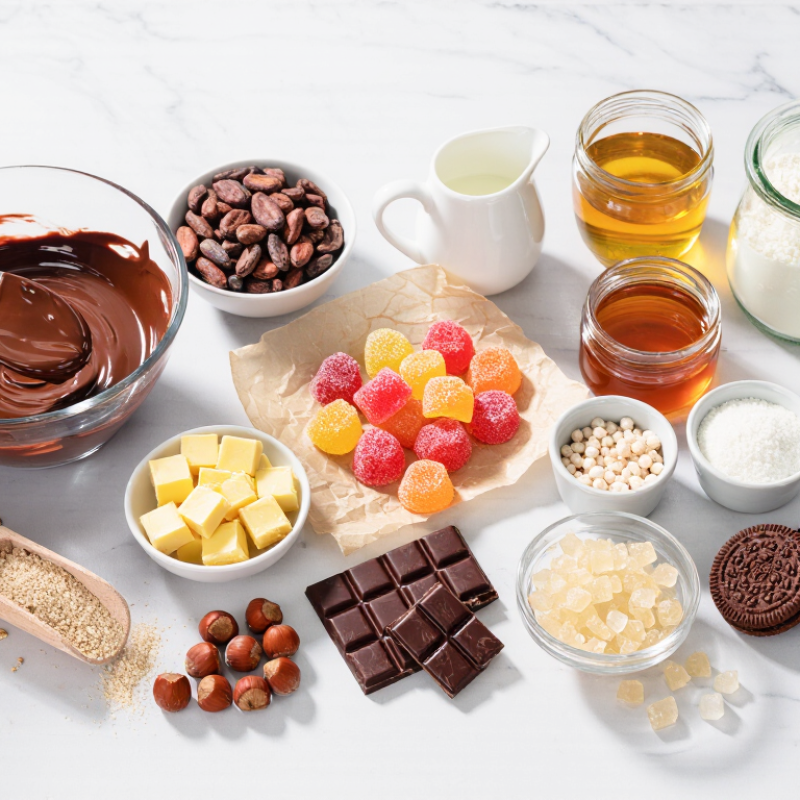
10 Best Confectionery Ingredients for Global Buyers

What Defines a High-Quality Confectionery Ingredient

10 Best Confectionery Ingredients for Global Buyers

What Defines a High-Quality Confectionery Ingredient

High-quality confectionery ingredients begin with reliable specifications, not attractive samples. Buyers should check purity, moisture, particle size, color, flavor, and microbiological limits. These details affect texture, shelf life, and production stability. A clean flavor matters. So does batch-to-batch consistency.

Strong suppliers provide traceability from raw material to final shipment. They should share recent laboratory results, allergen information, country-of-origin details, and storage instructions. Certifications can support confidence, but they do not replace independent evaluation. A supplier may meet a standard while the ingredient still performs poorly in a specific recipe. Small pilot tests reveal more than brochures. In my experience, heat exposure during transport is often underestimated, especially for cocoa powders, fats, syrups, and fruit-based ingredients.

Tips: Request samples from several production lots. Test them in the actual confectionery formula. Compare melting behavior, aroma, color, and aftertaste. Confirm packaging strength before placing a large order. Keep written acceptance criteria.

Global buyers should also review regulatory documents for each destination market. Approved ingredients, labeling rules, and contaminant limits can differ between countries. Clear documentation reduces customs delays and protects product quality. Still, paperwork is not enough. A perfect certificate cannot correct poor storage or inconsistent handling. Buyers should revisit supplier performance regularly, because quality can drift over time. That is an uncomfortable possibility, but ignoring it creates greater risk.

Core Sweeteners Used in Global Confectionery Production

10 Best Confectionery Ingredients for Global Buyers

Core Sweeteners Used in Global Confectionery Production

Confectionery buyers usually begin with sweetness, but production performance decides the purchase. Granulated sucrose remains a structural standard for hard candy, fondants, caramels, and panned centers. It provides familiar body, clean flavor, and controlled crystallization when moisture is managed. Glucose syrup adds viscosity and helps limit unwanted sugar crystals. Its dextrose equivalent, solids content, and color should match the recipe. Small specification changes matter.

Invert sugar supports softness and moisture retention in fillings, chews, and baked confectionery. It can also influence browning during heating. Fructose offers strong sweetness and useful moisture control, but excessive levels may create a sticky texture. Dextrose delivers a less intense sweetness and can support quicker crystallization in selected formulas. Maltose syrup brings mild sweetness and a fuller mouthfeel. These choices affect texture, shelf life, and shipping stability.

Polyols, including sorbitol and maltitol, help formulate reduced-sugar products with bulk and smoothness. Buyers should review local labeling rules and permitted usage levels before approval. In pilot batches, I would compare sweetness, water activity, viscosity, and crystal formation at the same temperature. A lower ingredient price can mislead when rework or unstable texture follows. Supplier documents should include origin, allergen status, microbiological limits, moisture, and batch consistency. One practical weakness remains: laboratory results may not predict every factory condition, especially during humid seasonal production.

Functional Ingredients for Texture, Stability, and Appearance

For global confectionery buyers, functional ingredients must perform consistently across recipes, climates, and production lines. Pectin creates a clean, fruit-like gel in jellies and gummies. Gelatin offers a flexible bite and smooth melt. Agar provides firmer structure, especially in warmer conditions. Modified starch can improve chewiness and reduce stickiness. Each option reacts differently to pH, sugar levels, and processing heat.

Lecithin helps cocoa-based fillings flow smoothly and reduces unwanted viscosity. Glycerol retains moisture, keeping soft candies from becoming hard too quickly. Sorbitol supports softness and helps control water activity. Citric acid sharpens fruit flavor while supporting pectin gel formation. Carnauba wax adds a dry, glossy finish to coated sweets. Natural color systems improve visual appeal, but their shade may shift under light, heat, or changing acidity.

Small details matter. A supplier should review purity, particle size, origin, documentation, and storage conditions before approval. Regional regulations can also affect permitted uses, labeling, and maximum levels. In practice, one ingredient rarely solves every quality issue. A gummy may need both pectin and moisture control. A chocolate filling may require lecithin, but excessive use can weaken its texture. Bench trials should measure firmness, gloss, melt, and shelf stability. Test before scaling. Some formulas look excellent on paper, yet fail after transport or humidity exposure.

10 Best Confectionery Ingredients for Global Buyers - Functional Ingredients for Texture, Stability, and Appearance

Ingredient Primary Function Texture Contribution Stability Benefit Appearance Impact Typical Use Level* Suitable Applications Key Buyer Considerations
Pectin Gelling and water-binding agent Creates a clean, short gel or a softer fruit-jelly bite, depending on type and formulation Helps control moisture migration and gel structure; high-methoxyl grades generally require soluble solids and acid Clear to translucent gels with good color release Approximately 0.5–2.0% Fruit jellies, pâte de fruit, gummies, fillings Choose grade according to pH, soluble solids, calcium level, and target gel strength
Gelatin Gelling, foaming, and emulsifying aid Provides elastic, chewy, melt-in-the-mouth or aerated textures Thermoreversible gel supports shape retention when correctly processed Can stabilize aerated structures and produce a smooth, glossy surface Approximately 0.5–3.0% Gummy candies, marshmallows, nougat, whipped confectionery Animal origin; verify source, bloom strength, halal or kosher status, and regional labeling rules
Modified Starch Thickening, gelling, and film-forming agent Delivers body, chew, firmness, or a smooth filling texture Selected grades can improve freeze-thaw, heat, shear, and acid tolerance Supports opacity, suspension, and consistent structure Approximately 1–8% Chewy candies, creams, fruit fillings, coatings, fondants Specify botanical source, modification type, viscosity, and applicable GMO requirements
Lecithin Emulsifier and flow aid Reduces viscosity and improves smoothness in chocolate and compound coatings Promotes uniform dispersion of cocoa solids, sugar, and fats Supports an even, glossy coating when processing conditions are controlled Approximately 0.1–0.5% Chocolate, compound coatings, nut pastes, caramel systems Common sources include soy or sunflower; check allergen declarations and local additive permissions
Glycerol Humectant and plasticizer Maintains softness, flexibility, and chewiness in high-solids products Binds water and can slow hardening or drying during shelf life Helps preserve a smooth, non-cracked surface Approximately 1–8% Soft candies, fondants, fillings, bars, chewy centers Excess use may create stickiness; monitor water activity, sweetness, and digestive tolerance
Sorbitol Humectant, bulking agent, and sweetener Provides body and helps retain a soft, chewy texture Reduces moisture loss and helps limit crystallization in selected formulations Supports a smooth, even appearance in sugar-reduced products Approximately 2–20% Sugar-free chewing gum, hard candies, fillings, fondants Polyol labeling and permitted-use requirements vary; high intake may have a laxative effect
Xanthan Gum Thickener and suspension stabilizer Adds viscosity and helps create a stable, pourable or spreadable texture at low levels Resists changes caused by heat, acid, and freeze-thaw cycles in many systems Helps keep particles, colors, and inclusions uniformly dispersed Approximately 0.05–0.5% Fruit sauces, fillings, syrups, reduced-sugar confectionery Small dosage changes can strongly affect viscosity; manage hydration and shear during mixing
Citric Acid Acidulant and pH regulator Provides a bright acidic profile and can influence gel formation and sugar crystallization pH adjustment can support preservation strategy and improve consistency in fruit systems Enhances perceived fruit color and flavor definition Approximately 0.1–2.0% Fruit chews, gummies, boiled sweets, sour coatings Control addition point and final pH to avoid excessive inversion, tartness, or gel weakening
Calcium Carbonate Mineral fortifier, acidity regulator, and color modifier Can contribute particulate body and improve firmness in selected compressed products Provides buffering capacity and may support calcium-dependent gel systems when appropriately formulated White pigment effect and increased opacity Approximately 0.5–5.0% Compressed candies, panned products, fortified confectionery Particle size, whiteness, purity, and heavy-metal specifications are important for global procurement
Carnauba Wax Glazing, polishing, and anti-sticking agent Forms a thin protective surface layer without materially softening the center Improves surface resistance to moisture, abrasion, and handling Creates a hard, glossy finish and helps maintain visual uniformity Approximately 0.05–0.5% Panned candies, dragees, chewing gum, decorative coatings Plant-derived; verify food-grade purity, melting point, coating compatibility, and local additive regulations

*Typical use level: Indicative formulation range by finished product weight. Actual dosage depends on ingredient grade, solids content, pH, water activity, processing conditions, and the desired sensory profile.

Global buyers should confirm current food-additive permissions, labeling requirements, allergen status, origin, certification needs, and specification limits in each target market.

Natural Flavors, Colors, and Specialty Additives

Global confectionery buyers increasingly seek natural flavors, clean-label colors, and specialty additives with reliable performance.

Natural vanilla, citrus, berry, and mint flavors can create recognizable profiles without overpowering sweetness.

Suppliers should provide source details, allergen statements, and dosage guidance.

Small details matter.

Natural colors bring different challenges.

Beetroot, spirulina, turmeric, and anthocyanins may change under heat, light, or varying acidity.

A bright shade in the laboratory may appear dull after baking.

Buyers should request stability data under real production conditions.

Test before scaling.

Specialty additives can improve texture, freshness, and processing efficiency.

Pectin supports soft fruit gels, while lecithin can improve chocolate flow and mouthfeel.

Moisture-control systems help protect filled candies during storage and transport.

Compatibility still needs practical testing.

That assumption failed in one pilot batch when a color faded beside acidic fruit filling.

The issue came from the formula, not the ingredient alone.

A dependable supplier should offer certificates of analysis, traceability records, microbiological specifications, and consistent technical support.

Regional regulations also differ, so documentation must match the destination market.

Sensory approval matters as much as laboratory data.

A flavor may meet every specification yet taste artificial to local consumers.

Feedback from small trial batches often reveals problems that spreadsheets miss.

How Global Buyers Evaluate Suppliers and Ingredient Compliance

10 Best Confectionery Ingredients for Global Buyers

How Global Buyers Evaluate Suppliers and Ingredient Compliance

Global confectionery buyers rarely choose an ingredient on price alone. They compare performance, documentation, and supply risk before approving a supplier. Sugar, cocoa powder, milk powder, starch, pectin, gelatin, lecithin, oils, flavors, and colors each need clear specifications. Consistent texture and taste matter across different production sites.

A credible supplier provides a current specification, certificate of analysis, allergen statement, and traceability record. Buyers check moisture, microbiological limits, heavy metals, pesticide residues, and declared additives against destination-market requirements. They also review origin, processing aids, packaging materials, shelf life, and storage conditions. Small gaps matter. An outdated test can delay a launch. Independent laboratory results strengthen confidence, but buyers should verify testing scope and sampling dates.

Supplier audits add another layer. Buyers examine hygiene controls, batch coding, recall procedures, worker training, and change-notification practices. A supplier should explain how it manages seasonal variation and raw-material shortages. Trial samples must perform in real recipes, not only in a polished presentation. Texture, bloom, melting, color stability, and flavor carryover can change during production. This is where some evaluations become too optimistic. A strong file can still hide weak communication. That weakness deserves attention before a long-term contract.

FAQS

What makes a confectionery ingredient high quality?

Reliable purity, moisture, particle size, color, flavor, and microbiological limits define quality. Consistent batches also protect texture and shelf life.

Why should buyers test ingredients in real recipes?

Laboratory data cannot predict every factory condition. Pilot tests reveal melting, aroma, color, aftertaste, viscosity, and crystallization problems.

What documents should suppliers provide?

Request laboratory results, allergen information, origin details, storage instructions, traceability records, and clear product specifications.

Are certificates enough to approve an ingredient?

No. Certificates support confidence but cannot replace independent testing. Poor storage may still damage a certified ingredient.

How can buyers evaluate sweeteners?

Compare sweetness, water activity, viscosity, crystal formation, and texture at the same temperature. Small specification changes can affect production.

What should buyers know about reduced-sugar ingredients?

Polyols can provide bulk and smoothness. Check local labeling rules, permitted usage levels, and possible texture changes before approval.

Why do natural colors need extra testing?

Heat, light, and acidity can change their appearance. A bright sample may look dull after baking or mixing.

How should buyers test flavors and specialty additives?

Run small batches in the final formula. Check flavor strength, mouthfeel, texture, and consumer suitability, not only laboratory results.

How can transport affect ingredient quality?

Heat exposure can damage cocoa powders, fats, syrups, and fruit ingredients. Strong packaging and suitable storage instructions are essential.

How should global buyers manage supplier performance?

Keep written acceptance criteria and review suppliers regularly. Quality may drift over time, even when paperwork remains unchanged.

Conclusion

This guide explores the 10 best Confectionery Ingredients for global buyers, beginning with the qualities that define reliable, high-quality materials. It explains how purity, consistency, traceability, food safety, and stable performance influence ingredient selection. Core sweeteners are reviewed for their roles in sweetness, bulk, flavor balance, and product structure, while functional ingredients are introduced for improving texture, stability, moisture control, appearance, and shelf life.

The guide also highlights natural flavors, colors, and specialty additives that help manufacturers create appealing and differentiated confectionery products. In addition, it outlines how international buyers evaluate suppliers through documentation, quality systems, production capabilities, testing procedures, packaging, logistics, and regulatory compliance. By considering both technical performance and responsible sourcing, buyers can build dependable supply chains and select ingredients that support consistent product quality across different markets.

Elena

Elena

Elena is a dedicated marketing professional with extensive expertise in our company's product offerings. With a keen understanding of market dynamics and consumer behavior, she excels in creating compelling content that not only highlights the unique features of our products but also aligns with......